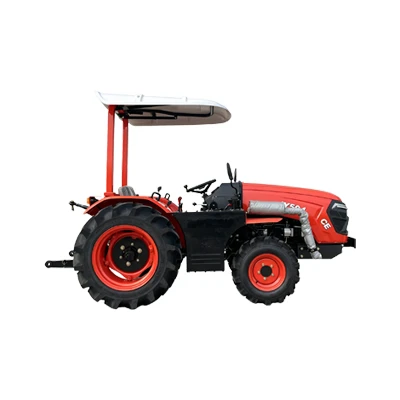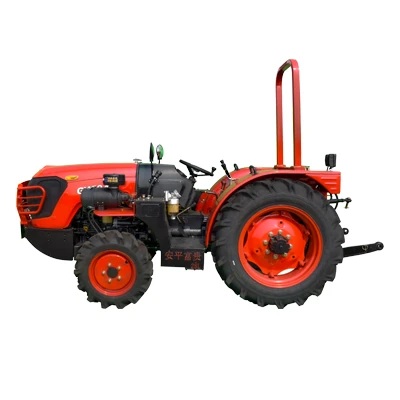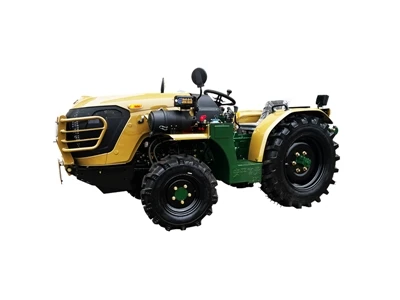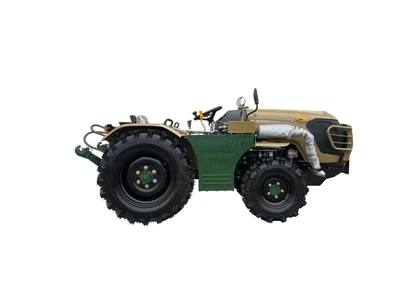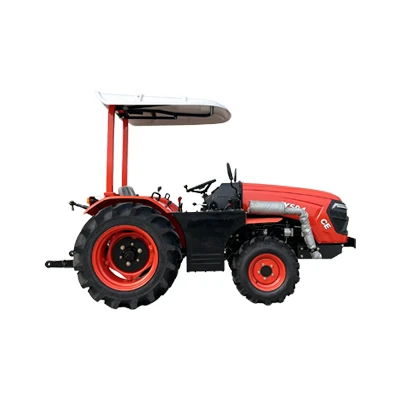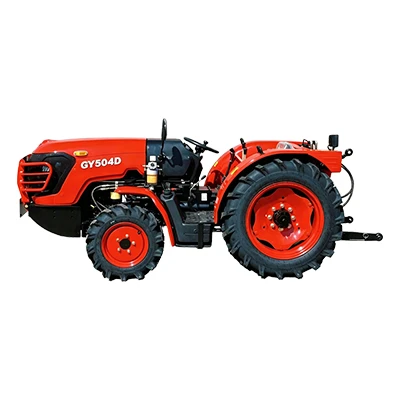
Dimensions:
Length x Width x Height: Common dimensions range from 3.5 to 5 meters (length), 1.6 to 2.2 meters (width), and 2.4 to 3 meters (height).
Wheelbase: Adjustable from 1.1 to 1.5 meters to accommodate different crop row spacing requirements.
Wheelbase: Typically between 1.8 and 2.5 meters, it affects the tractor's stability and turning radius.
Ground Clearance: Typically between 300 and 500 mm, it determines its maneuverability and terrain adaptability.
Powertrain: Available power ranges from 20 to 200 horsepower. Small tractors (20-50 horsepower) are suitable for orchards or greenhouses, medium tractors (50-100 horsepower) are suitable for conventional farmland, and large tractors (over 100 horsepower) are designed for heavy-duty operations. Power Take-Off (PTO): Standard speed is 540 rpm or 1000 rpm, with spline sizes typically ranging from ∅35mm to ∅38mm.
Transmission: Various gear configurations are available, including 8+8 and 12+12. Some models are equipped with synchronizers or powershift.
Clutch: A dry, single-plate, double-acting clutch is the mainstream design, offering clean disengagement and durability.
Steering: Hydraulic steering is common, offering easy and precise operation.
Travel System:
Drive: 2WD (rear-wheel drive) or 4WD. 4WD models are better suited for wet or sloping terrain.
Tire Sizes: Common front tire sizes range from 7.5-16 to 9.5-24, and rear tire sizes range from 11.2-28 to 16.9-34. Tire pressure should be adjusted according to load.
Hydraulics and Suspension:
Lift System: The high-pressure dual-cylinder design provides greater lifting force, suitable for heavy implements. Three-point hitch: Conforms to ISO Cat I or Cat II standards, with the lower tie-bar spacing typically 720mm or 820mm.
Other Parameters:
Fuel tank capacity: 50L to 120L, affecting operating time.
Machine weight: 1.5 to 5 tons, depending on the type of operation (e.g., deep plowing requires counterweight).